


Before anyone lodges yet another formal complaint against reality, let’s orient ourselves. What you’re looking at is an actual map of the nature of all things in existence and how they align with reality. I spent the last few years charting the terrain so try not to spill anything on it.
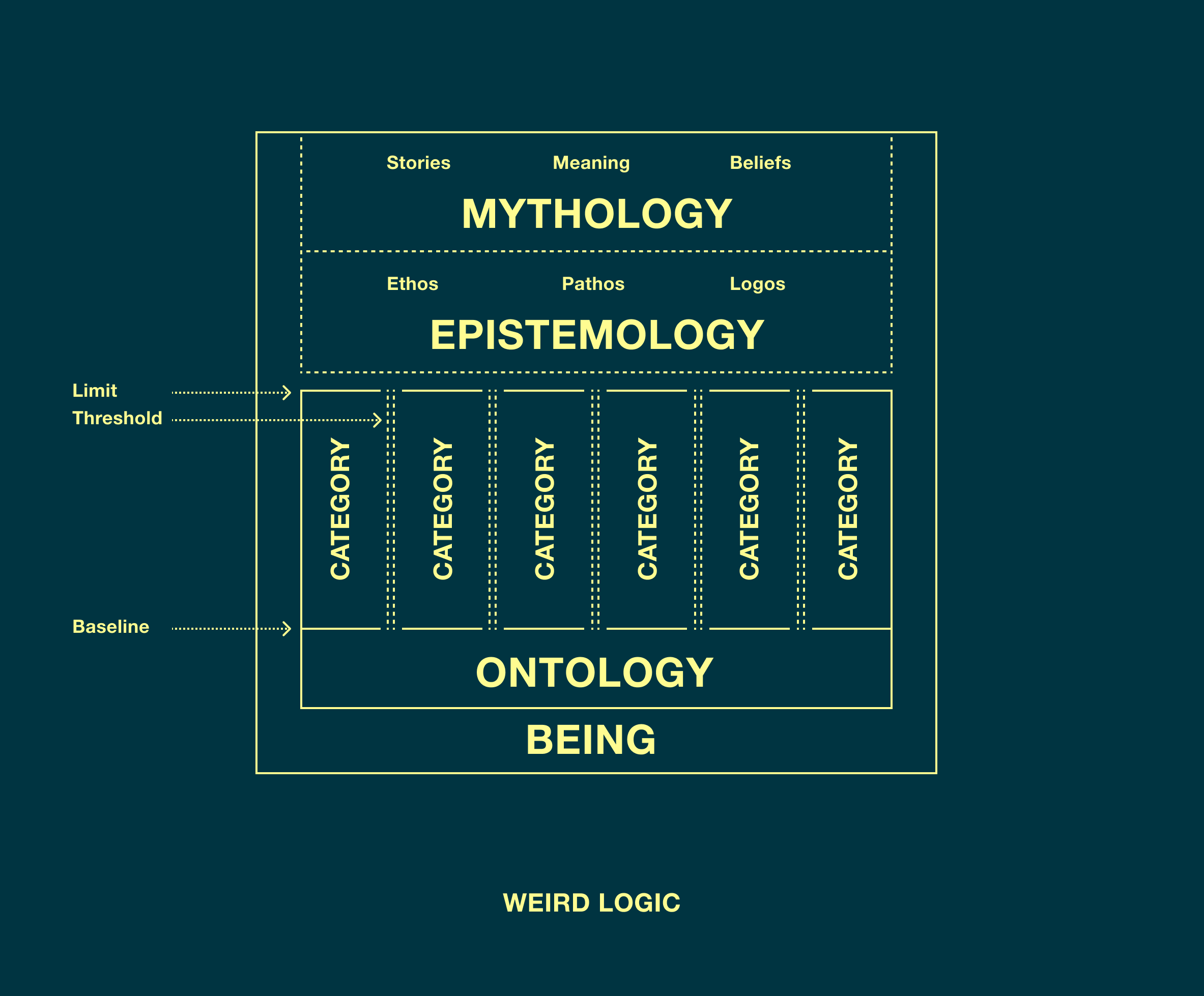
First, we must acknowledge the existence of a thing called “Being.”
It can be anything you want, provided it is not you, Ashley Tisdale’s toxic mom group, or anything detectable by the five senses. It is generally reserved for whoever was responsible for the Big Bang—assuming, of course, that the Big Bang was not simply the early stages of an intergalactic highway project that ran wildly over budget.
This Being has a thankless job. It must keep the laws of nature humming along in perfect order while acting as the most aggressively hands-off babysitter imaginable to an ant farm of humans who cannot be trusted alone for more than two seconds without inventing cryptocurrency, ideology, or both at the same time.
Ontology is arguably Being’s sleight of hand. It’s a kind of meta-terrain that only becomes visible once all your other explanations collapse in on themselves. To reach it, you have to unpack the top two layers of everything you believe and set them gently on fire.
This is why most people avoid ontology entirely unless they’ve committed to a lifetime of monkery, or—if you’re like me—developed an unusually high tolerance for uncertainty without trying to control what’s inside. Which, statistically speaking, narrows the field to about 1% of the population. No wonder my Substack doesn’t scale.
On the surface, ontology seems almost insultingly basic. Trees are trees. Mountains are mountains. Words mean things. Easy. Child’s play. But don’t be fooled. Ontology is far trickier than it looks. It asks questions like:
Is this a Truth or a Power-Grab?
Is there a Limit to my sense of Control?
Is this a War or am I trapped in the Comment Section of a video about a war, which is a different ecosystem and just as poisonous?
This map was first surveyed by a few men who caused enormous inconvenience by asking the same obvious questions—Socrates, Plato, and Aristotle.
Socrates wandered around pointing at things and asking,“Are you sure that’s what you think it is?” Which everyone found unbearable.
Plato took it to the next level by staring directly at the rich and powerful and informing them that laws were not, in fact, the load-bearing structure of existence.
Aristotle followed behind him with labels, categories, and a stone clipboard saying,
“No, seriously—this is a cliff. If you treat it like a launchpad, you will die.”
Between them, they established a radical principle:
Different kinds of things exist and confusing them has consequences.
For centuries, people navigated this terrain instinctively. Houses were shelter. Silence was sometimes just silence. Gravity was a non-negotiable.
Then, right here by the cat videos…everything changed.
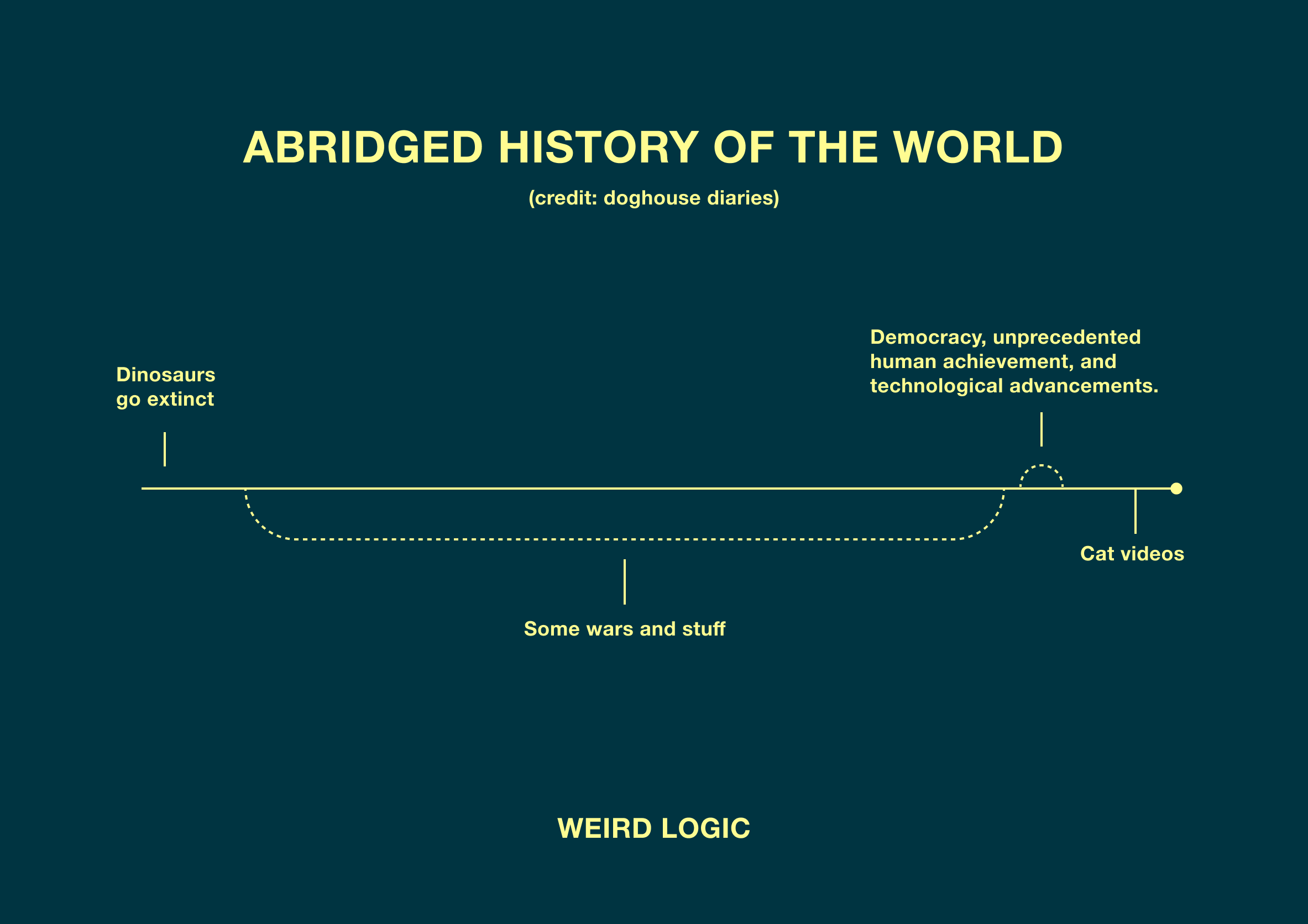
No one remembers the exact date, but cartographers agree it was a Tuesday since Mondays are slow and Fridays are too hopeful. They looked at the map and said:
“The elders were archaic. Now for something completely different.”
That was the moment we became wildly confident in our engineering abilities. Why merely understand the world when you can refactor it? If we didn’t like the dominant narratives however noble, self-imposed, or emotionally expensive, we simply redefined what counted as knowledge. That sure showed them.
The map, it was decided, mattered less than the stories we told about it, and especially less than how quickly those stories could go viral. Stories became Evidence. That made Feelings flood Policy. This caused Tribalism to be compressed into Media. And then Celebrities performed Activism. Brands hardened into Heritage.
At this point, ontological categories were no longer respected. They were optional like speed limits or the concept of “indoors.”
Create limits where none belong and wander freely across thresholds that were never meant to move, and the downstream effect is predictable. You end up standing on a six-dimensional paradox, endlessly exiting into the room you just entered, confidently mistaking a Circular Loop for the Fall of the Roman Empire.
As per human tradition, distinguishing regions is an act of rebellion. The reward is a Resistant to Change stamp and a gentle drop-kick into Problematic dungeon, despite having the clearest sense of reality available.
Thus The Great Ontological Blur—a historic achievement in which civilization slowly collapsed mythology, epistemology, ontology, and Being itself into two sleek, efficient categories:
Us and Them
Which, incidentally, is the same operating system used by feudalism. A bold choice, given the intent was Justice and Equality.
So if the world feels meaningless, chances are you’ve accidentally become a rule-hoarding gargoyle guarding the Gates of Correctness. Congratulations. Nature did not hire you for this role and you may promptly go home now.
That corner office will never be ours because we have Limited encounters with Reality. And much like the ancient Mayan’s limited understanding of weather, a drought does not mean the world is ending. It means you are experiencing a drought. Subtle difference—a very important one.
Ontological categories exist for a reason and that reason is not to ruin your fun. Here’s how to navigate it while keeping your arms and legs inside the plane for your safety:
Limits tell you how much of a thing you can have before it starts consuming itself. Power, attention, abstraction, certainty—each has a point where it quietly turns corrosive. Past that point, you don’t get more of the thing. You get its breakdown.
Baselines tell you what remains when you step back. When you stop managing, optimizing, narrating, or rescuing. They’re the minimum conditions that keep a thing a thing even in the absence of your supervision. If removing your control causes something to disappear entirely, it was never real in the first place.
Thresholds are the boundaries that keep one thing’s category from impersonating another. They’re what prevent Feelings from becoming Laws, Stories from becoming Evidence, or Symbols from demanding the privileges of Concrete Reality. Cross a threshold accidentally and you don’t transcend anything—you just collapse two systems into a rather confusing plumbing issue much like that scene in The Shining.
But here’s the good news. Learn to fly between categories without trying to run the cockpit and you get better jokes, foolproof logic, and stories that tell the truth the way Lewis Carroll always did—where nonsense turns out to be exact and meaning has somewhere to land.
This was the original navigation system. Long before arguments lost nuance, sailors crossed entire oceans by trusting a few stubborn stars that refused to move just because someone felt lost. Nuclear fission showed up much later. Getting home came first.
This was not fundamentally anti-progress. Farmers learned when to plant and when to stop fussing by watching what the land was already doing, not by trying to improve it by changing its terrain.
It was not the definition of anti-science. Healers learned to tell the difference between a fever and a curse by noticing what kind of thing a body is, rather than what they hoped it might be.
It never needed narrative control. It’s how you tell whether you’re looking at a door or a wall before walking into it repeatedly and insisting the wall is emotionally unavailable.
Ignore the map long enough and confidence expands to fill the space where orientation used to be. Moral panic follows shortly after.
Fix the categories and surprise, surprise…everything finally works as reality intended.
Nobody could have said it better, and that timeline was brilliant.