


This is the first experiment in a series where I’ll be using my ontological framework to stress-test thinkers from every corner of the political galaxy, even the ones I personally swear by.
The goal is to spot the exact moment a perfectly confident argument takes a wrong turn at the metaphysical off-ramp and ends up in a charming little subdivision called “Not Actually Reality.” We’re looking for those paradoxical glitches where the claims sound profound and logically airtight, yet the whole thing quietly detaches from the structure of existence, which is, of course, a minor detail.
This framework isn’t something I cooked up at 2am next to a cold slice of pizza. It’s a re-mapping of very old insights about how reality is organized—the kind Aristotle was already cataloging before indoor plumbing was cool, with philosophical guest appearances from Hannah Arendt and Plato, who both spent a great deal of time pointing out that we humans are extremely talented at mistaking our own projections for the universe—prompting Pluto to file a restraining order.
In short, we’re not here to dunk on people. Only to watch how ideas gently drift from ontology into interpretive fan fiction and maybe learn how to keep our own thoughts from doing the same.
Alright, strap in. It’s time to introduce our first brave volunteer in this completely safe and definitely not explosive intellectual experiment.
Stepping up to the plate is someone I genuinely consider a friend here on Substack. One of those rare humans who makes this whole platform feel less like a comment section and more like a lively salon. She has that unfair ability to enter a space and immediately upgrade the vibes through sheer grace and intentionality.
I’ve re-stacked her posts more than once and if you’ve been hanging around my corner of the internet for any length of time, odds are you’ve enthusiastically nodded along with her words too.
So please direct your warmest, most scientifically calibrated applause toward Anuradha Pandey of Radically Pragmatic, who is fully aware she’s first in line for this ontological obstacle course and has agreed to participate in the spirit of curiosity and only minimal metaphysical turbulence.
Without further ado, this is Operation: Ontological Edition. Try not to touch the thresholds.
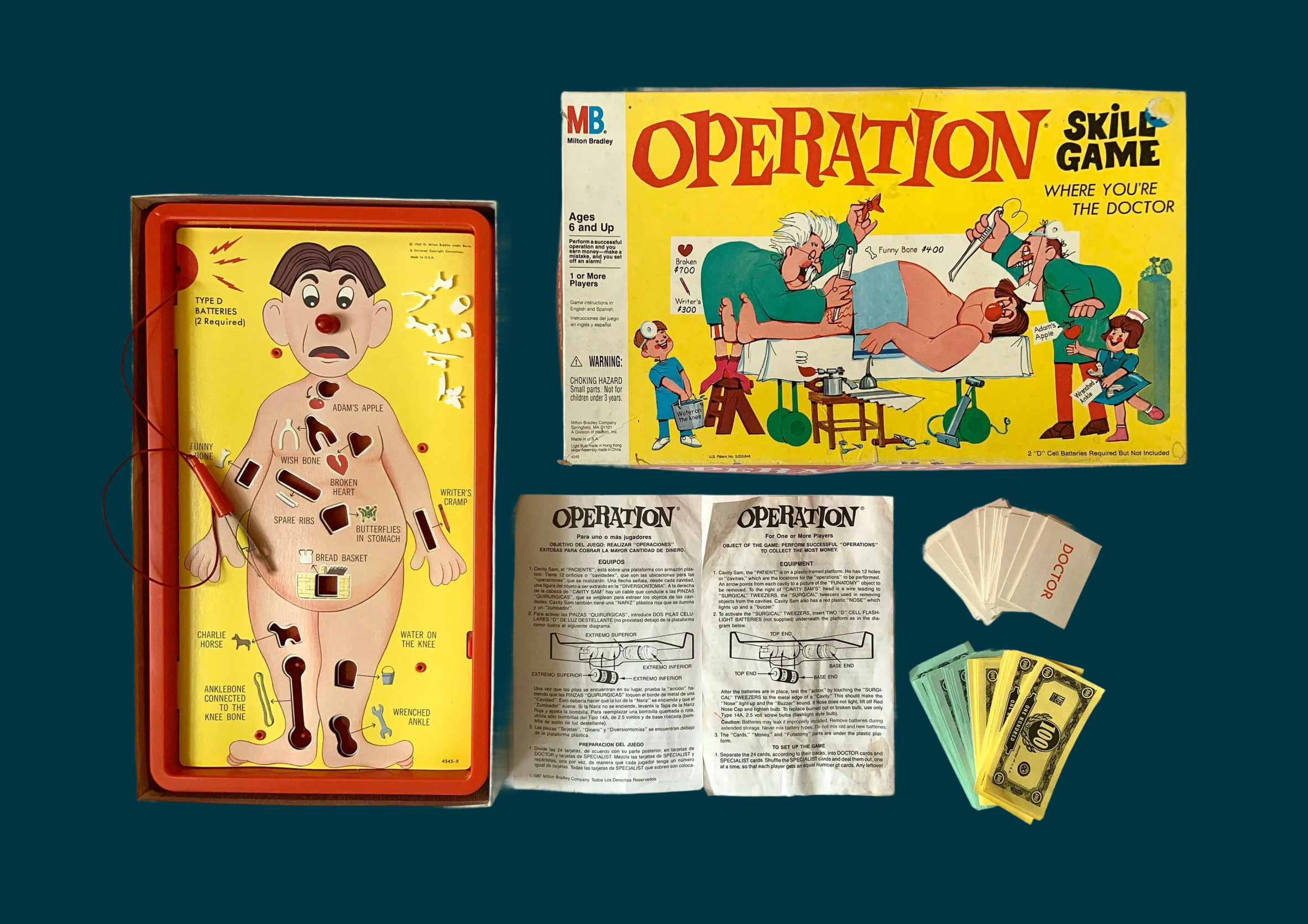
You, dear reader, are the surgeon. The article is the patient, the ontological categories are the organs, and the buzzer is reality screaming NOPE.
Your job is to remove each condition without collapsing a primary organ.
Recognizing baselines without tearing a hole in the fabric of the universe earns you points.
If the writer’s hand starts to shake and the tweezer begins to wobble, that’s the stage where the argument is technically still alive, but everyone in the room has started sweating.
You lose points when you fail to notice the writer setting off the buzzer—triggering a minor reality (and organ) failure. Nothing catastrophic, just widespread meaning loss.
And every time the argument says “therefore” with cascading confidence, and we forget to notice, we all bow solemnly to the universe and agree to step away from the table for awhile until we get back to baseline.
Scoring
✅ Clean move: +3
⚠️ Threshold wobble: +1
🚨 Collapse (buzz): –3
💥 Cascading collapse: –5
🧠 Name the collapse? +2 with bragging rights
🎮 HOW TO PLAY
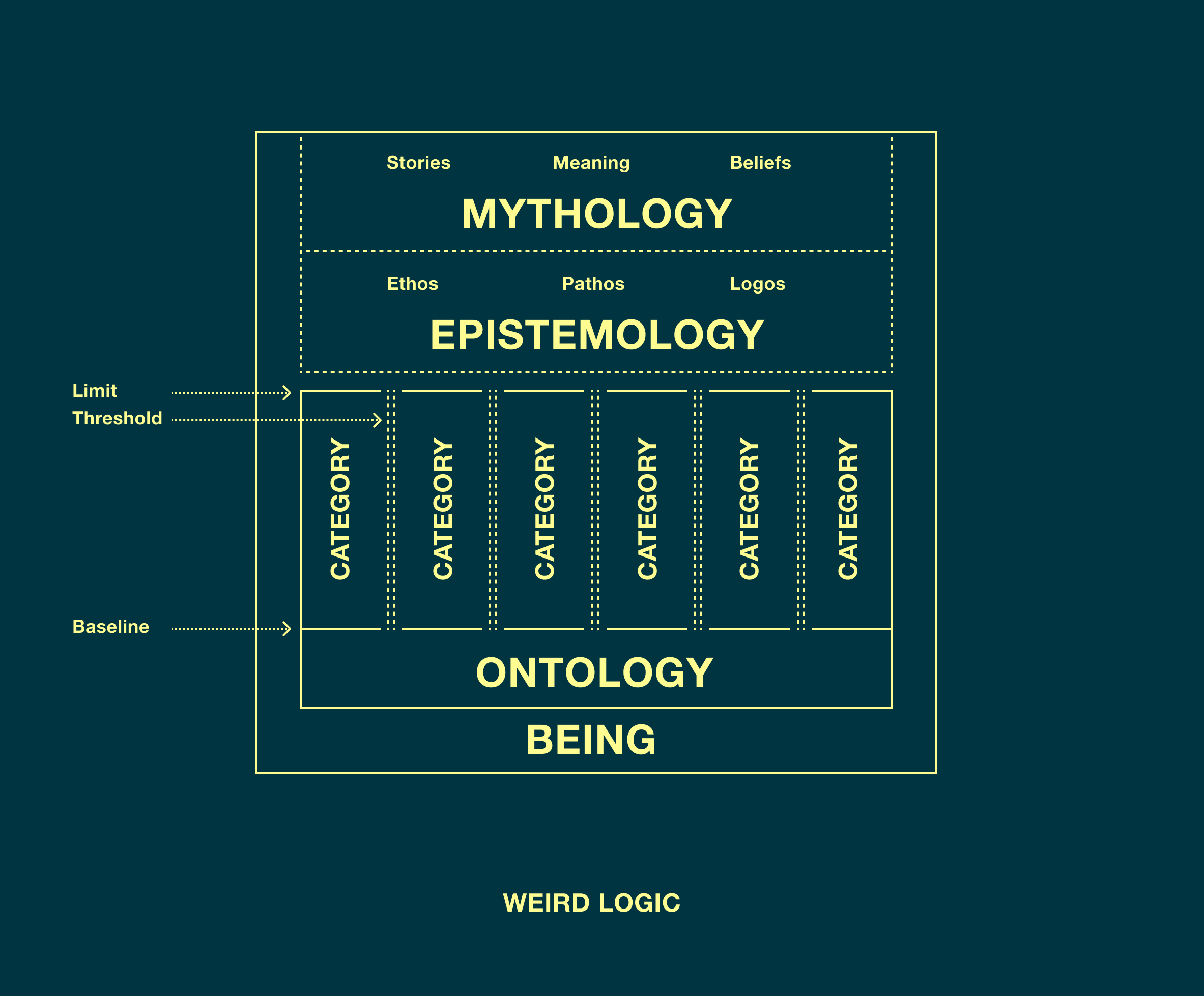
For each condition, ask yourself these questions:
✅ What am I actually standing on, really? This is your baseline.
🐉 Mythology? (a story I like)
🧐 Epistemology? (how I know things)
🧱 Ontology? (what exists)
💫 Being? (the cosmic universe)Sort the claims. Does it shape-change into a bigger classification without showing the work?
That’s your threshold. Keep pushing and you’ll hit the limit. The board buzzes 💥, the red light flashes 🚨, and objective reality has collapsed. BZZZZT.
The patient has rolled into the operating room.
🫀 PART I: “The Broken Heart”
There is a regression to the mean; in mixed gender groups, abstract thoughts and debate are banished in the name of politeness. Of course, in a room of creative class people, everyone will say they want debate to signal the openness that this class values so much. But they don’t actually practice openness to new ideas. Indeed, women are almost entirely unlikely to test ideas in a social setting to reach the truth because reports about people and relationships dominate our conversations.2 That’s like nails on a chalkboard for me.
Read the passage again. Slowly. Like you’re defusing a philosophical bomb with plastic tweezers.
Ask yourself the two questions above. When you feel reasonably confident you haven’t opened a wormhole, scroll down and check your work.
✅ BASELINE (Safe Removal)
“reports about people and relationships dominate our conversations.”
You’re standing on Logos—an Epistemological Pattern of observable behavior in female contexts.
If you got this right, give yourself +3 points
Reality remains structurally sound.
🚨 LIMIT (BUZZER)
“Women are almost entirely unlikely to test ideas to reach truth.”
🚨 BZZZZT
And there it is.
The Pattern becomes Basically Always, and mutates into into a theory about Females As An Inferior Gender (compressed ontology), and as a charming side effect, casts Female Debate Enthusiasts as More Evolved (mythical folklore). 💥
That’s a full category cascade beyond what a single classification can do in reality.
This sort of kinetic surge occurs when a moral bruise slips past security, wanders into the control room, and starts adjusting the universal settings so reality better matches how one feels on the inside, or how unexamined narratives become totalizing according to Plato.
Totally understandable. We just try not to publish it as physics as these theories play out in rather predictable ways. But stories about goblins, dwarves, and “people who are bit much at dinner” would be exquisite.
If you got this wrong, subtract 5 points
Organ failure.
✏️ PART 2: “Writer’s Cramp”
Knowledge and wisdom cannot foment where debate is banished. Women’s spaces are, therefore, reflexively anti-wisdom. Individual women in them may be wise, but the spaces are ruled by the lowest common denominator. Wisdom requires sharpening your knowledge, practicing discernment, and most importantly, acknowledging openly when you’re wrong. In practice, men are far more comfortable doing so despite the narrative. Their being less generally driven by emotion allows for this, which is why I bristle when I hear men should be more openly emotional.
✅ BASELINE (Safe Removal)
“Knowledge and wisdom”
Ways humans pressure-test ideas and occasionally prevent themselves from believing nonsense. You’re standing on epistemology.
Score: +3 (if identified)
Solidly in reality.
🚨 LIMIT (BUZZER)
“Knowledge and wisdom cannot foment where debate is banished. Women’s spaces are, therefore, reflexively anti-wisdom.”
🚨 BZZZZT
Fascinating claim.

Anuradha’s favorite cheese (Logos) has now been promoted from helpful epistemic instrument to Sole Licensed Distributor of Wisdom (Ethos).
Wisdom (Ethos) does not, however, increase with argument density (Logos). If it did, the internet would have achieved enlightenment by 2009 and we’d all be levitating above our chairs.
If you got this wrong, subtract 3 points
Organ failure.
🐴 PART 3: “Charlie Horse”
Feminine relational-emotional speech norms cannot be the foundation of a functioning society. Logical reasoning must rule the public sphere, or we won’t ever escape our current malaise. It’s no accident that Democrats are the party that can’t seem to build anything new and are stuck in maintenance mode. Life seems to be a series of meetings and processes with poor outcomes.
✅ BASELINE (Safe Removal)
“Feminine relational-emotional speech norms”
Pathos—an observable pattern in sociological settings.
Score: +3 (if identified)
Totally legitimate.
🚨 LIMIT (BUZZER)
“Feminine relational-emotional speech norms cannot be the foundation of a functioning society.”
“Logical reasoning must rule the public sphere.”
“Democrats can’t build anything new because of this.”
🚨 BZZZZT
Logos just got promoted from a helpful reasoning tool to the load-bearing beam of civilization. Pathos, meanwhile, has been downgraded from “part of being human” to “design flaw responsible for societal decline.”
Wisdom is what happens when you don’t let any single dial run the whole spacecraft, but learn how to fly with all of them in harmony.
Score: -3 (if you got this wrong)
Organ failure.
🦴 PART 4: “Wish Bone”
I was ultimately ejected because of a conflict with another woman over her behavior in controlling a meetup the group was trying to plan (never addressed directly, of course). But the situation was illustrative because the stage of the conflict was actually set in the very beginning when I brought up the problems with DEI, trying naively to engender discussion in the group chat. But the default ideological mode of groups of millennials these days is leftism, backed up by whatever identity labels one has. My going against the social incentives for an Indian-American woman was the ultimate unforgivable sin for this group, so the Korean-American woman kicked me out.5 I mention her race to illustrate that I wasn’t just betraying women, but also women of color. That’s an even bigger sin.
✅ BASELINE (Safe Removal)
“I was ultimately ejected because of a conflict with another woman over her behavior in controlling a meetup the group”
Perfectly normal human drama. People disagree. Feelings get weird. Someone makes an executive decision. This is Pathos, not a doctoral thesis on civilization.
Score: +3
No metaphysical organs have been disturbed.
🚨 LIMIT (BUZZER)
“The conflict connects to ideological disagreement about DEI.”
“The default mode of millennial groups is leftist identity ideology.”
“My disagreeing as an Indian-American woman was an unforgivable sin.”
“A Korean-American woman removed me because I violated identity loyalty rules.”
🚨 BZZZZT
And we have liftoff.
This is no longer “something weird happened in my group” (pathos). It’s bold. It’s ambitious. It’s “how Millennials and Women of Color fundamentally function as moral actors.” A total collapse of being, ontology, epistemology, and mythology into one totalizing narrative. 💥
Slow clap.
Score: -5 (if incorrect)
Organ failure.
🦴 PART 5: “Funny Bone”
The solution here should be self-evident: women need to become more comfortable with debate, which would be us transcending our biologically reinforced inclinations through a different socialization pattern. This is my cross to bear, especially. Our discourse is poor because challenge is absent both online and in life. The dialectical reasoning process required to move society forward is entirely missing from our spaces. But why wouldn’t women who consider themselves empowered want to be challenged?
✅ BASELINE (Safe Removal)
The solution here should be self-evident: women need to become more comfortable with debate
This is an appeal to Logos based on an observable pattern.
Score: +3
Sociological in nature.
🚨 LIMIT (BUZZER)
“transcending our biologically reinforced inclinations through a different socialization pattern.”
“The dialectical reasoning process required to move society forward is entirely missing from our spaces.”
“why wouldn’t women who consider themselves empowered want to be challenged?”
🚨 BZZZZT
Houston, we appear to have launched a category into orbit and I don’t see a retrieval plan. What you’re watching is a confusion between what appears changeable and what actually is.
A biological tendency (ontology), usually living in the modest neighborhood of influencing behavior sometimes, extends beyond its limits as a barrier for human survival.
Clearly the only reasonable response is a sweeping ontological software patch titled “Woman 2.0: Now Less Catty.” Please restart your woman.
Nature, however inconvenient, isn’t the enemy. It’s the vehicle that makes all categories coherent.
Score: -3 (if incorrect)
Organ failure.
🧮 FINAL SCORE
+15 or higher:
🧙♂️ Ontological surgeon. Gravity thanks you for being so grounded.
+5 to +14:
🛠️ You hit the buzzer, but the patient is still metaphysically stable.
0 to +4:
😬 Total organ failure. Remarkable confidence throughout.
Below 0:
🚑 The board lit up. Maybe don’t explain reality for a bit.
Don’t worry, I still think Anuradha Pandey is a fantastic writer and a genuinely sharp thinker. This wasn’t a hit piece. It was more of a “let’s see how gravity works on all of us” demonstration.
The point isn’t to shame people when their reasoning goes sideways. Under the right conditions, anyone can wander into tiny-tyrant territory, especially when they’re trying to do something good. The goal here is just to help us all notice ontological drift and gently rotate back towards true north.
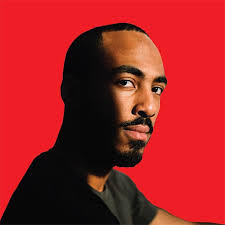
Tune in next time, when I bravely submit one of my favorite thought leaders, Coleman Hughes, to the same completely unbiased and definitely safe ontological stress test.
No one is immune. That’s what makes it fun.
An eminently fair assessment that may move me in the future to write differently :)
I now live for this series.