


This is the second experiment (see the first here) in a series where I’ll be using my ontological framework to stress-test thinkers from every corner of the political galaxy, even the ones I personally swear by.
The goal is to spot the exact moment a perfectly confident argument takes a wrong turn at the metaphysical off-ramp and ends up in a charming little subdivision called “Not Actually Reality.” We’re looking for those paradoxical glitches where the claims sound profound and logically airtight, yet the whole thing quietly detaches from the structure of existence, which is, of course, a minor detail.
This framework isn’t something I cooked up at 2am next to a cold slice of pizza. It’s a re-mapping of very old insights about how reality is organized—the kind Aristotle was already cataloging before indoor plumbing was cool, with philosophical guest appearances from Hannah Arendt and Plato, who both spent a great deal of time pointing out that we humans are extremely talented at mistaking our own projections for the universe—prompting Pluto to file a restraining order.
In short, we’re not here to dunk on people. Only to watch how ideas gently drift from ontology into interpretive fan fiction and maybe learn how to keep our own thoughts from doing the same.
Now before we start the ontological surgery and accidentally remove a philosophical kidney, let’s begin with something radical.
Respect.
Because my next victim on the operating table is someone with more moral courage than someone ending a free trial before it’s over. He’s one of the few people who walked into the psychological haunted house of 2020 with a flashlight instead of a flamethrower, which, at the time, was basically heresy.
He didn’t moralize people into the abyss, treat disagreement like a felony, or talk like half the country needed to be exiled. In an era where silence was violence and the preferred love language for most people left of center was a molotov cocktail thrown at their bffs, he kept speaking like a person who believed others were still human. And for a lot of people, myself included, that mattered.
Because Coleman Hughes is not some foam-at-the-mouth chaos machine. He’s human, just like the rest of us, and perfectly capable of hitting Ctrl-Z on the laws of physics when a topic gets pulled into a time warp.
So without further ado, this is Operation: Ontological Edition. Try not to touch the thresholds.
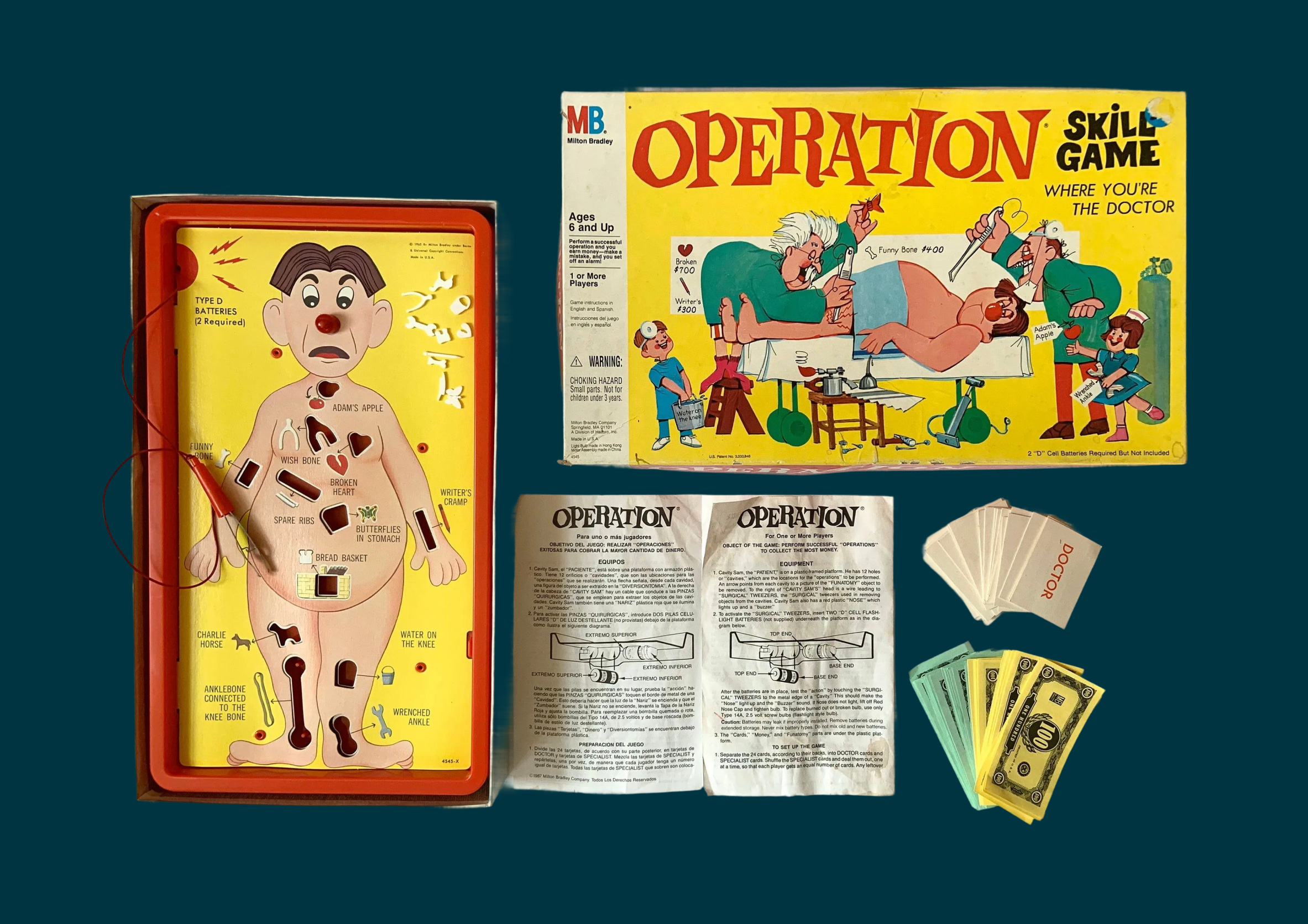
You, dear reader, are the surgeon. The article is the patient, the ontological categories are the organs, and the buzzer is reality screaming NOPE.
Your job is to remove each condition without collapsing a primary organ.
Recognizing baselines without tearing a hole in the fabric of the universe earns you points.
If the writer’s hand starts to shake and the tweezer begins to wobble, that’s the stage where the argument is technically still alive, but everyone in the room has started sweating.
You lose points when you fail to notice the writer setting off the buzzer—triggering a minor reality (and organ) failure. Nothing catastrophic, just widespread meaning loss.
And every time the argument says “therefore” with cascading confidence, and we forget to notice, we all bow solemnly to the universe and agree to step away from the table for awhile until we get back to baseline.
Scoring
✅ Clean move: +3
⚠️ Threshold wobble: +1
🚨 Limit (buzz): –3
💥 Cascading collapse: –5
🧠 Name the collapse? +2 with bragging rights
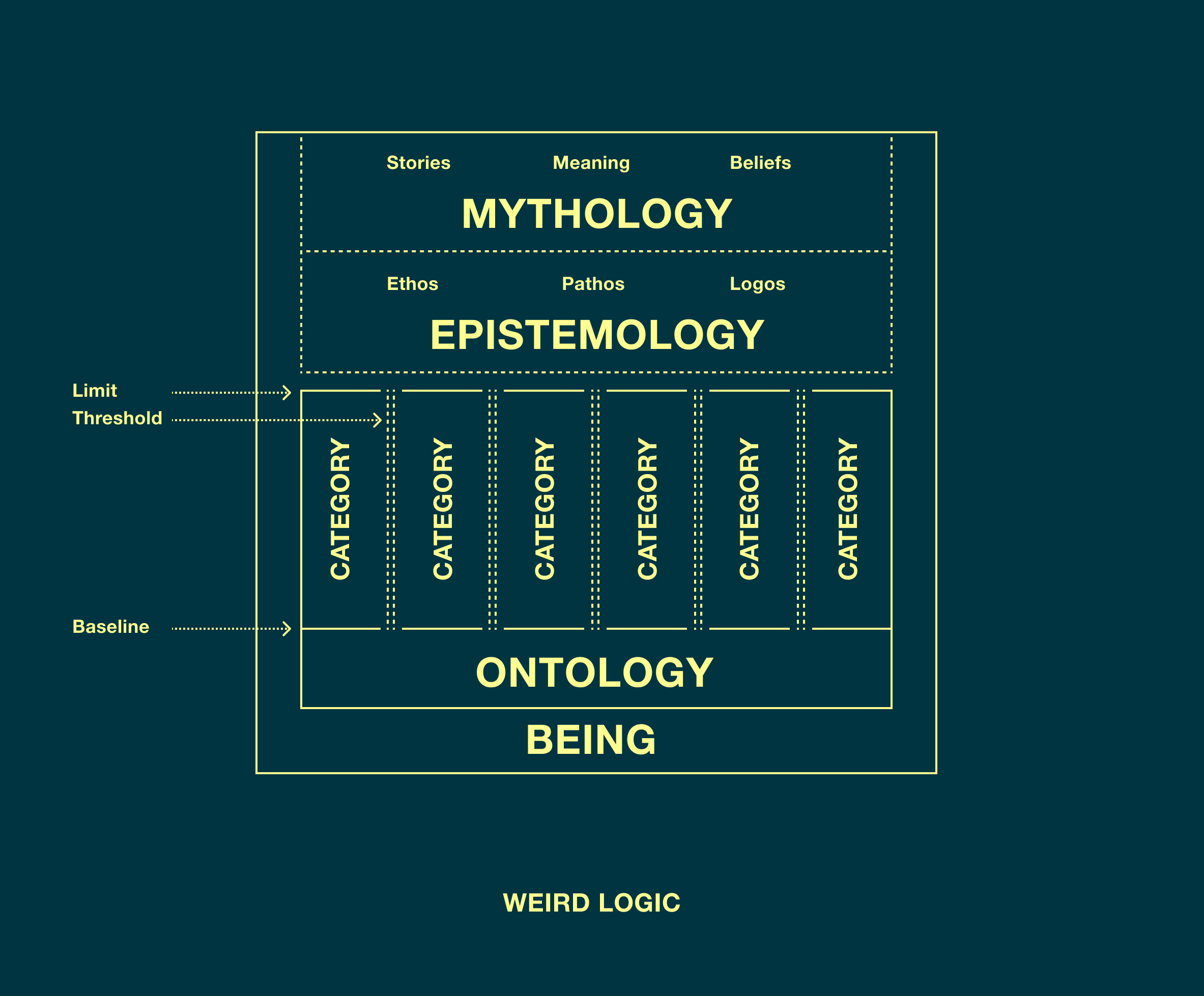
🎮 HOW TO PLAY
For each condition, ask yourself these questions:
✅ What am I actually standing on, really? This is your baseline.
🐉 Mythology? (a story I like)
🧐 Epistemology? (how I know things)
🧱 Ontology? (what exists)
💫 Being? (the cosmic universe)Sort the claims. Does it shape-change into a bigger classification without showing the work?
That’s your threshold. Keep pushing and you’ll hit the limit. The board buzzes 💥, the red light flashes 🚨, and objective reality has collapsed. BZZZZT.
The patient has rolled into the operating room.
🦴 ORGAN 1: “The Ankle Connected To the Knee Bone”
“Yet to study the history of slavery, as my students found out, is to learn quickly that up until two and half centuries ago, slavery existed just about everywhere—without any significant movements against it.”
✅ BASELINE (Safe Removal)
You’re standing on Ontology and Epistemology. Slavery has been the bane of existence across many civilizations since the dawn of time.
If you got this right, give yourself +3 points
Tragically real.
🚨 LIMIT (BUZZER)
None yet. But if you’ve already cranked the dial to Max Conspiracy Mode, go ahead and deduct 3 points and maybe go for a walk outside.
🐴 ORGAN 2: “Charlie Horse”
“When Europeans first ventured into Africa, they encountered a slave trade that had been thriving for centuries, if not millennia. Starting with the Islamic conquests of the seventh century and lasting well into the twentieth century, some 14 million Africans would be taken to the Arab world as slaves. Just as often, African tribes enslaved one another, and some tribes went to war specifically to procure slaves.”
[…]
When Americans say that our slavery was the worst example, what they are actually revealing is that it’s the only example of slavery they know anything about.
[…]
The result has been that the American left, which controls most of the meaning-making institutions, has forged a political identity rooted in the belief that American slavery was unique (or at least uniquely awful)”
✅ BASELINE (Safe Removal)
You’re standing on Ontology and Epistemology. He has observed the cultural Pattern across time and space that slavery was universally reviewed as “zero stars, would not recommend.”
If you got this right, give yourself +3 points
Truly awful for everyone involved.
⚠️ THRESHOLD (Wobble)
“what they are actually revealing is that it’s the only example of slavery they know anything about.”
That’s a category jump from a Pattern (Epistemology) to Mind Reading (Mythology) like we were tracking footprints in the sand and suddenly teleported through a shimmering portal.
If you got this right, give yourself +1 point
We were over there and now we’re over here? And now we’re back over there 😵💫.
🚨 LIMIT (BUZZER)
Then he gets a little cocky about knowing what women want like Mel Gibson in a rom-com and decides that if what they want to study isn’t Uniquely American, it must not really count as Formative.
A fascinating new rule for how civilizations work. By that logic, we should probably retire baseball from our national brand too since Japan also figured out how to hit a ball with a stick and, frankly, sometimes better than we do.
If you got this wrong, subtract 3 points.
Toto? I don’t think we’re in Kansas anymore.
🧠 ORGAN 3: “Brain Freeze”
“The backlash was fierce. ‘People wanted to kill me, man,’ Gates said of the public reaction to the essay. ‘Black people were so angry at me. But we need to get some distance from the binary opposition we were raised in: evil white people and good black people. The world just isn’t like that.’
Evil white people and good black people. That is the lesson imparted, intentionally or not, by downloading into one’s brain a version of history that includes American slavery and omits slavery everywhere else.
[…]
The result has been that the American left, which controls most of the meaning-making institutions, has forged a political identity rooted in the belief that American slavery was unique (or at least uniquely awful) and characterized by the subconscious mantra: Evil white people and good black people. This subconscious belief (literally) colors the patterns of thought, feeling, and action that Americans on the left exhibit today.”
✅ BASELINE (Safe Removal)
You’re standing on Epistemology observing the cultural Pattern of Mythological Stories about collective guilt and innocence. My only wish is that it would arrive in the form of “The Winds of Winter” sometime before I become a wise old tree.
If you got this right, give yourself +3 points
People tell stories. Totally legitimate.
⚠️ THRESHOLD (Wobble)
A binary opposition that some people have becomes the whole
“subconscious belief [that] (literally) colors the patterns of [every] thought, feeling, and action that Americans on the left exhibit today.”
Now we’re not in a grand, unfolding civilizational story anymore. It’s a psychic hotline where we’ve apparently unlocked the Progressive Hive Mind. We know what they want, how they feel, what motivates them, and probably their Starbucks order, too1.
If you got this right, give yourself +1 point
What soul did he sell for this gift? Like, was it a full Faustian situation or just a lightly used spare?
🚨 LIMIT (BUZZER)
Complex social narratives now have a single historical cause. We have entered Mono-Cause Land from Formation (ontological category) to Original Sin (mythological belief) without showing the work. At this rate we might as well blame the emphasis on American slavery for forgetting the whipped cream on my matcha latte.
BZZZZT ⚡🚨
A cascading collapse. Subtract 5 points if you got this wrong.
Full organ failure.
🍞 ORGAN 4: “Bread Basket”
“The good news is that just as narratives about history got us into our present situation, changing the way we approach history will get us out.
We must attack the root of the problem: the American public’s historical memory. Instead of whitewashing the grim facts of American slavery—as American history textbooks did in the past, and as certain corners of the American right would be all too happy to revive—I recommend taking the opposite approach: adding material rather than subtracting it.
We must include the global and ubiquitous nature of slavery in every school curriculum. We must pull every lever in our education system to ensure that no American graduates high school believing that slavery was intrinsically American, or confined to specific races. Only when that is achieved—when our collective historical memory is broadened—will we be able to unite as a country, end the slavery blame game, and restore a sense of color-blind morality.”
✅ BASELINE (Safe Removal)
You’re standing on Epistemology observing how education shapes understanding. Ontology, or knowledge of what is, influences those belief systems.
If you got this right, give yourself +3 points
Fair enough.
🚨 LIMIT (BUZZER)
It was short lived.
“We must include the global and ubiquitous nature of slavery in every school curriculum.[…] and restore a sense of color-blind morality.”
That’s a jump from a curriculum change (Epistemology) to the very nature of society (Being) as it if were holy water. Knowledge can do a lot, but it doesn’t come with resurrection powers.
If you got this wrong, subtract 3 points
Organ failure.
🧮 FINAL SCORE
+14 or higher:
🧙♂️ Ontological surgeon. Gravity thanks you for being so grounded.
+6 to 13:
🛠️ You hit the buzzer, but the patient is still metaphysically stable.
0 to +5:
😬 Total organ failure. Remarkable confidence throughout.
Below 0:
🚑 The board lit up. Maybe don’t explain reality for a bit.
Roast aside, I still think Coleman Hughes is a generational thinker and one of the few people who can walk into a moral thunderstorm without trying to smite anyone.
But fairness demands balance. I’ve just poked a few of my own tribe with the ontology stick, so tune in next time when I hop the fence to see what kind of category gymnastics the left at The Atlantic has been doing while insisting they’re just “following the science.”
Peer-reviewed by the High Priestess of Obviously, whose methodological standard is “trust me.”
Is this new game show gonna feature any prominent philosophers? Because I think a couple of big names need some serious re-examining.